
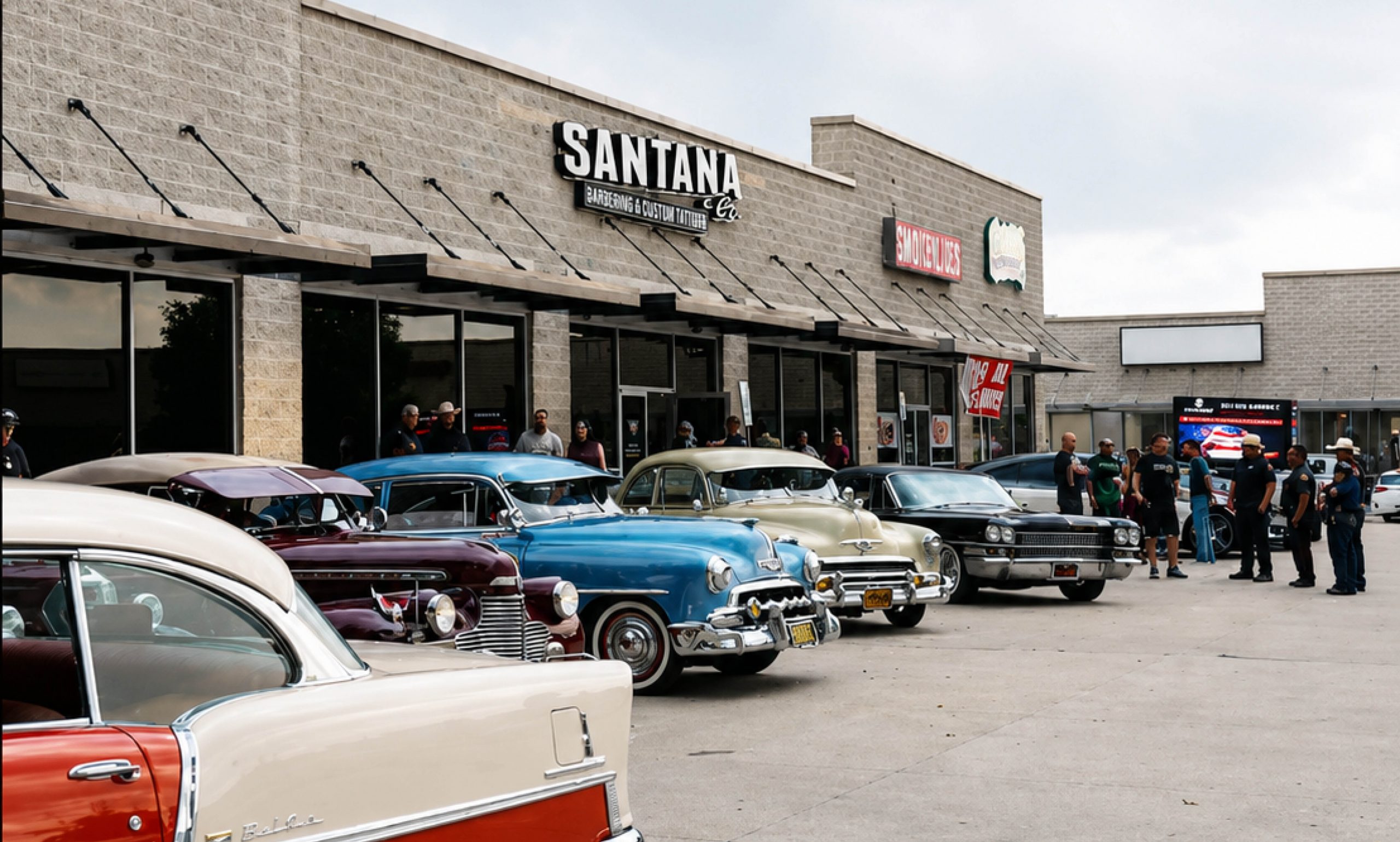
Santana & Co had already rewritten the rules of scalp micropigmentation in Texas. The new challenge was bigger: put barbering, SMP, tattooing, permanent makeup, and education under one roof.
Three weeks after opening their new 5,500-square-foot space in Fort Worth, it was clear this wasn’t just another barbershop expansion. It was an experiment in what a modern grooming hub could look like.
“I’ve been in the industry going on 14 years, and I’ve never seen anything like this,” said Sam Garcia, the brains behind Santana & Co.
“I’ve traveled all over the country, and I’ve never seen a space that has tattooing, permanent makeup, scalp micropigmentation, barbering, and education all together.”
One roof, many careers
Around 20 professionals work inside the Santana & Co space, and the energy is of a shared ecosystem rather than a row of competing chairs. A client might walk in for a haircut and walk out with a new tattoo consultation booked, or come in for SMP and end up planning a full sleeve.
“Somebody will come in for a haircut, then realize they want a tattoo as well,” Sam explained. “It just all complements each other. Everyone’s clientele is one big community.”
From a barber’s perspective, that meant built-in cross-promotion without the pressure of fighting for the same fades and beard trims as the person at the next station.
“It’s not like you’re fighting for clients. You can come to me, go to him, go to them, do it all at once.”
In simple math: nine barbers cutting five to ten people a day means roughly 200 clients a week walking past tattooers and SMP artists. Each tattoo artist then brings their own clients back into the barbering and education side.
Designed for work, not Instagram
Visually, the space was built to feel open and communal, while still hitting strict sanitation and licensing standards. It took about a year just to secure the licenses.
“The space has to be big enough to do all this for sanitation,” he explained. “You can’t cram everything in. Our space is 5,500 square feet, all sectioned out perfectly.”
The fit-out was another story of risk and instinct. Santana met with manufacturers a year before the space was approved, and started designing custom stations, lighting, and furniture down to the last detail.
They skipped traditional tattoo chairs and installed remote-control dental beds instead, making long SMP and tattoo sessions more ergonomic for both artist and client.
The gamble came when he put down around $50,000 on equipment before the city had even voted on his licensing.
“If they didn’t vote it in, then I wouldn’t have a building, but I’d still have 30 crates of equipment arriving. That’s the risk you take in business.”
On January 7, the council voted in his favor. The bet paid off.
Education at the core
For Santana & Co, the space was more than just a flashy buildout. It functioned as an education center for barbers, tattoo artists, SMP specialists, and PMU professionals.
They bring in one to two high-level educators each month, focusing on quality over social media numbers. SMP remains Sam’s “bread and butter,” but all the education arms carry equal weight in the new space.
The vision did not stop at one location. Santana talked openly about franchising the concept globally within the next year and hinted at serious interest from major partners. Aftercare giant H2Ocean also came on board as a sponsor, underlining how seriously other segments of the industry were taking the experiment.
What barbers should take from this
For working barbers, Santana & Co’s new space wasn’t just a cool build; it was a signal of where the profession could go:
A barber no longer has to stay in a single-lane career for life. In a space like this, they could cut hair, learn SMP, explore tattoo or PMU education, and plug into a wider creative culture without leaving a shop environment. The idea was not to abandon barbering, but to expand it.
“I’ve been on the streets before,” he said. “If it all fails, I’ve been there. What do I have to lose?”