
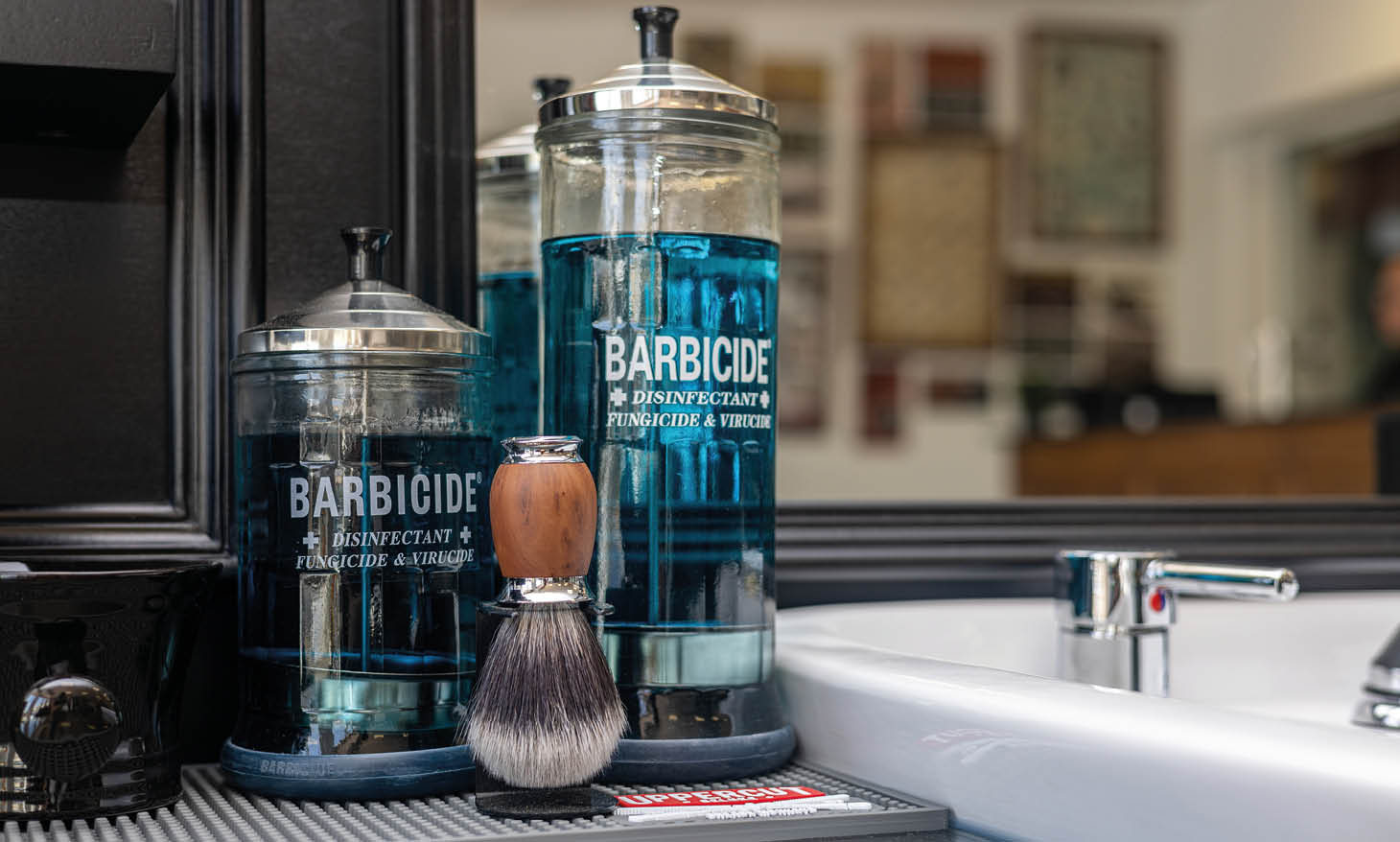
Every barbershop has two essential responsibilities: keeping clients safe and protecting the business if something goes wrong. Disinfecting tools between appointments and understanding the limits of an insurance policy are opposite sides of a barber’s work, but both are crucial parts of running a shop.
For Ivan Zoot, educator and ambassador for BARBICIDE, the priority is clear. Barbers need to learn the fundamentals of health and safety in school, but he believes that knowledge must translate into action once they enter the workplace.
“You have an obligation to protect the public,” said Ivan. “This obligation is greater than your responsibility to do good haircuts. Infection control is job number one. Know what to do. Know how to do it. Do it.”
Clean Tools Make Safer Shops
Every barber shares responsibility for maintaining a safe environment. According to Ivan, some of the most common failures involve everyday tools and routines like dirty brushes being reused on multiple clients, clippers and trimmers not being properly disinfected, or disinfectant mixed at the wrong concentration.
The commercial stakes are high. “One incident could wipe out your business,” Ivan warned.
Luckily, errors are avoidable when a shop establishes clear procedures. Zoot advises barbers using BARBICIDE concentrate to remember “two to 32 and dump every day” – two ounces of concentrate to 32 ounces of water, with fresh solution prepared daily. Users should follow the label directions, including contact time and immersion instructions.
“Let’s not make disinfection complicated or scary,” he said. “Mix it properly and mix it fresh daily. BARBICIDE is really easy to use properly. It is all printed right on the bottle.”
Ivan pointed to the free online BARBICIDE Certification, widely used in industry education as a way of reassuring clients. Displaying a current certificate signals the shop takes protection seriously, just like the familiar jar of blue disinfectant is a recognizable symbol of cleanliness.
Preparing for the “What Ifs”
“Barbering is a skilled profession, but it’s also a business,” said Shawn Woedl, CEO of InkShopGuard Insurance. “Every day, barbers operate in an environment where accidents can happen despite the best precautions.”
Those incidents might include a client injury, allergic reaction, infection allegation, damaged property, theft or lawsuit. Insurance can protect what a barber or owner has built and reduce the financial strain of a claim.
Shawn explained that barbers should consider general liability and professional liability at a minimum. General liability can address claims involving bodily injury or property damage, while professional liability is for claims arising from services performed, including cuts, irritation, infections and related allegations.
Employees are often covered by their employer’s insurance, although owners and staff should confirm the extent of that protection with the insurance agent. Independent contractors and chair renters generally need their own liability policies and may need to name the shop owner as an additional insured.
Suite renters typically require individual liability coverage and may also need business personal property protection for equipment. Shop owners should consider general and professional liability, property insurance, workers’ compensation where required, and other coverage suited to the shop’s structure.
Remember, your exact needs depend on your working arrangement, and coverage requirements can vary depending on the policy, contract and jurisdiction.
The Questions Every Barber Should Ask
The details deserve close attention. Shawn cautions that policies are not interchangeable, and a low price can disguise significant gaps. A barber might carry general liability but have no professional liability coverage for claims arising directly from barbering services.
When comparing policies, professionals should examine exclusions for professional services, provisions involving contractors and chair renters, product liability for items used or sold, assault and battery coverage, limits for tools, furniture and buildouts, and business interruption protection following a covered loss.
“The most important question is not simply, ‘Do I have insurance?’ but ‘Does my policy actually cover what I do every day?’” said Shawn. “Many coverage gaps aren’t discovered until a claim occurs, which is often the worst possible time to find out.”
For someone becoming self-employed or opening a first shop, insurance should be part of the foundation alongside licensing, premises, equipment and client acquisition.
Shawn recommended using a provider familiar with barbershops and that use plain-language explanations.
InkShopGuard’s own proposition is specialization. Having first served tattoo shops and artists that were frequently misunderstood by traditional providers, the company recognized similar issues in barbering. Shawn said that its aim is to reflect how contemporary shops operate while emphasizing education and service.
Ultimately, a safe barbershop is built through disciplined daily habits and informed business decisions. Correct disinfection helps prevent harm; suitable insurance prepares the business for incidents that precautions can’t eliminate.